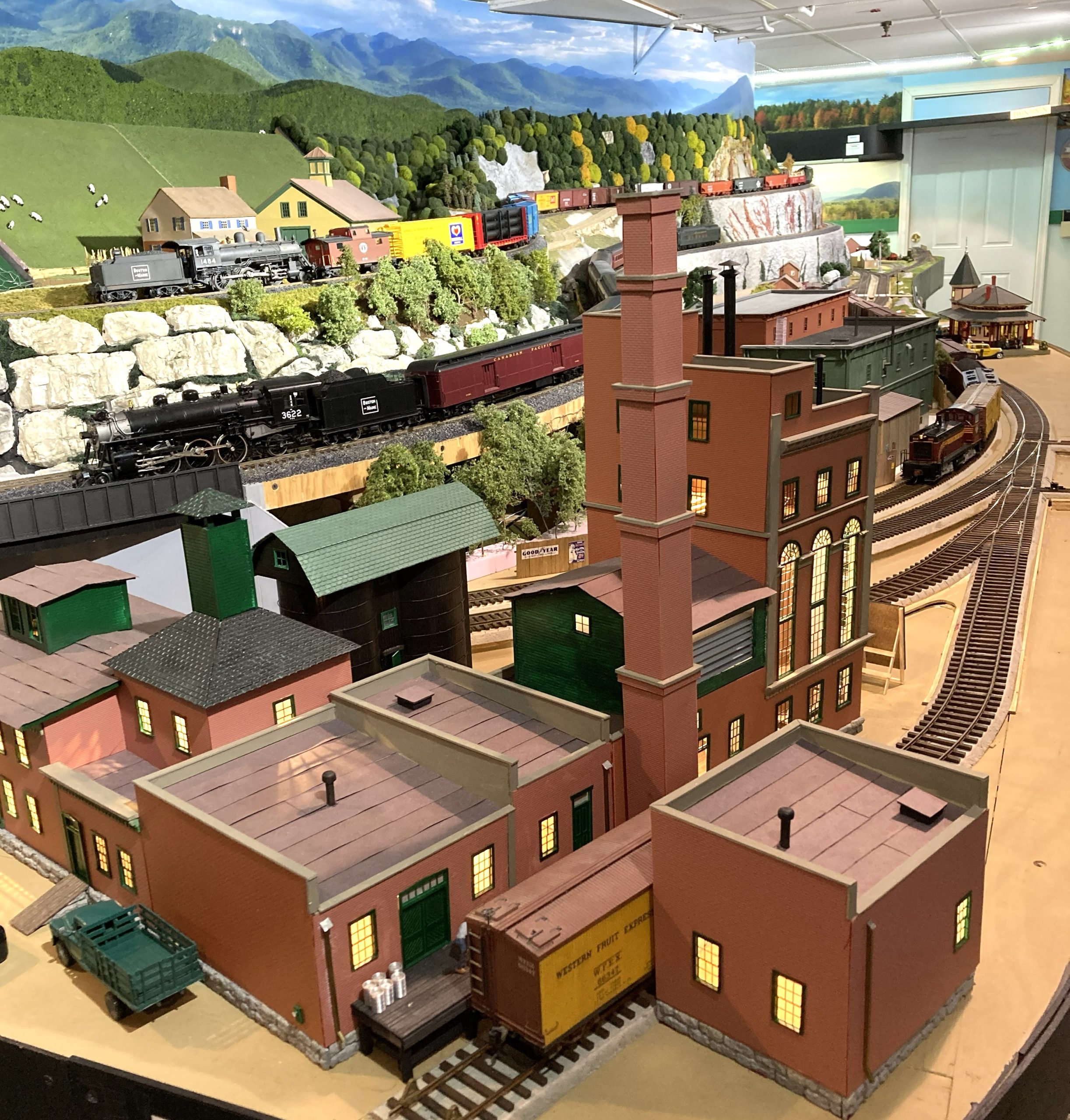
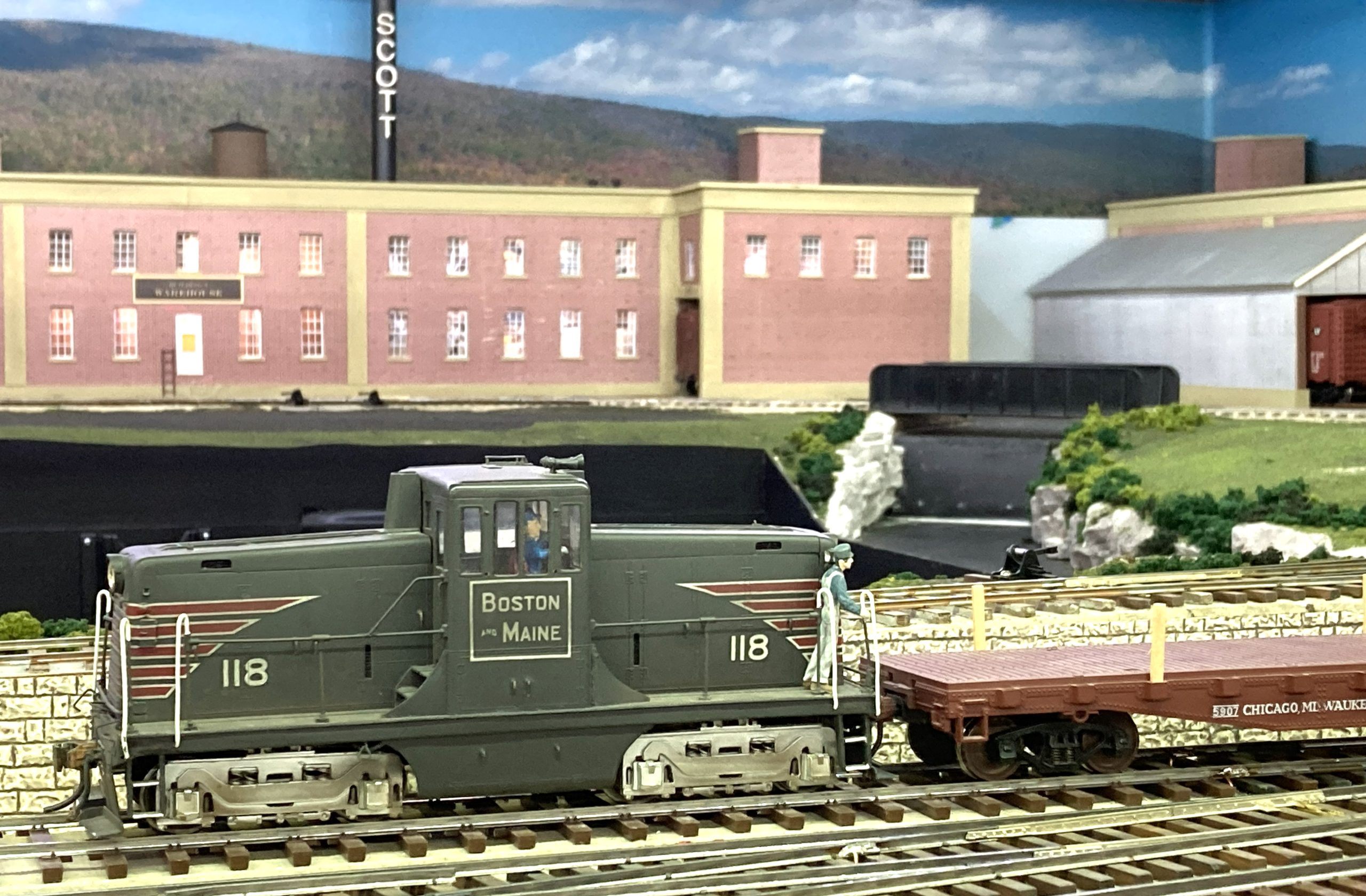
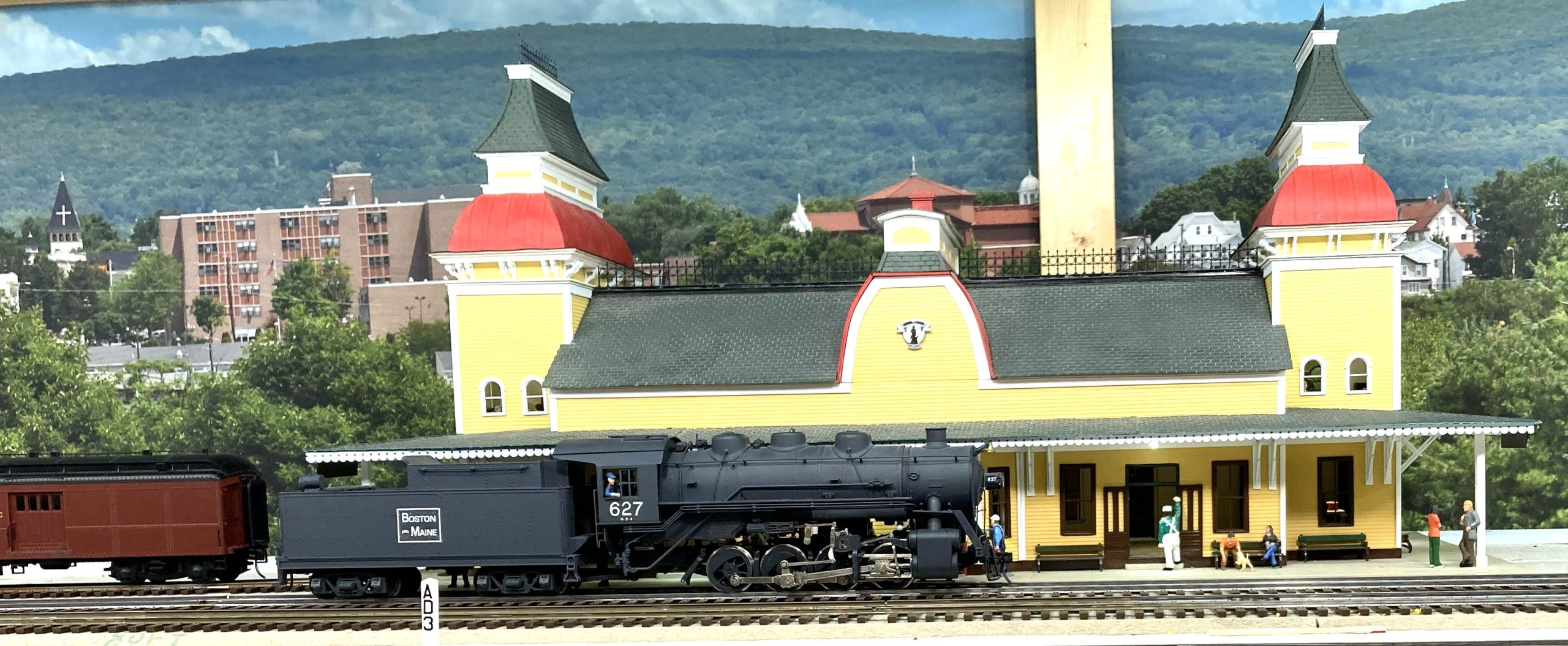
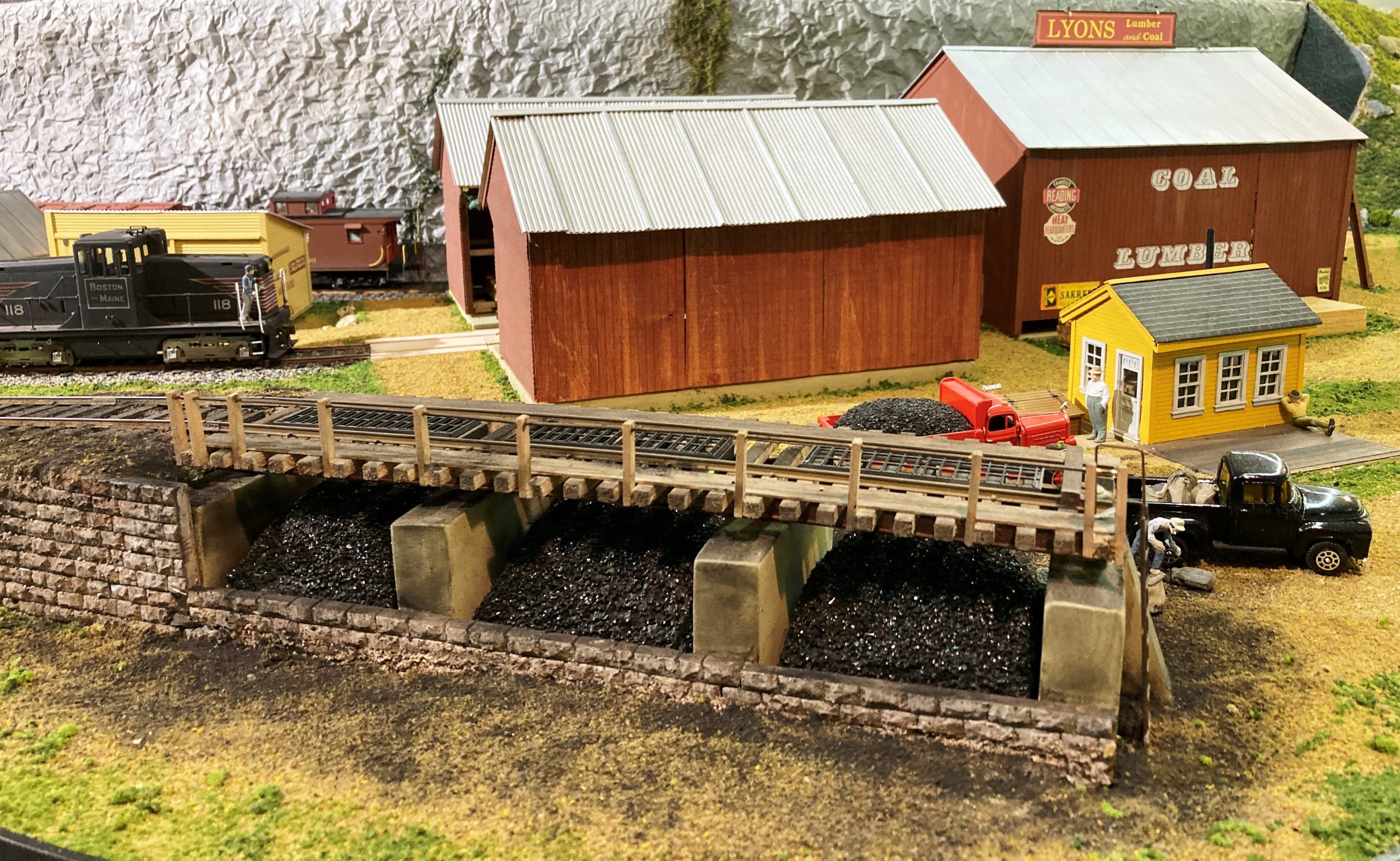
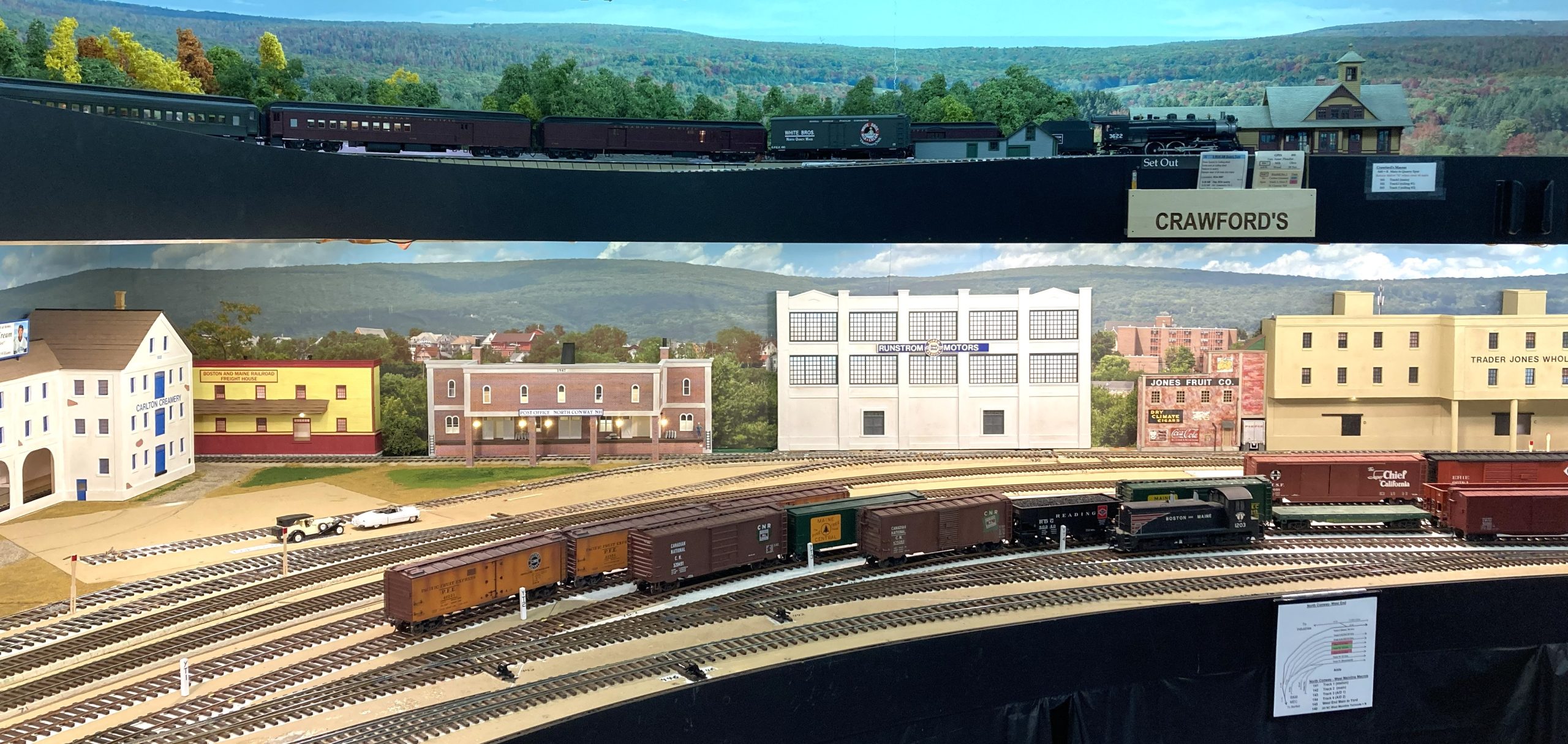
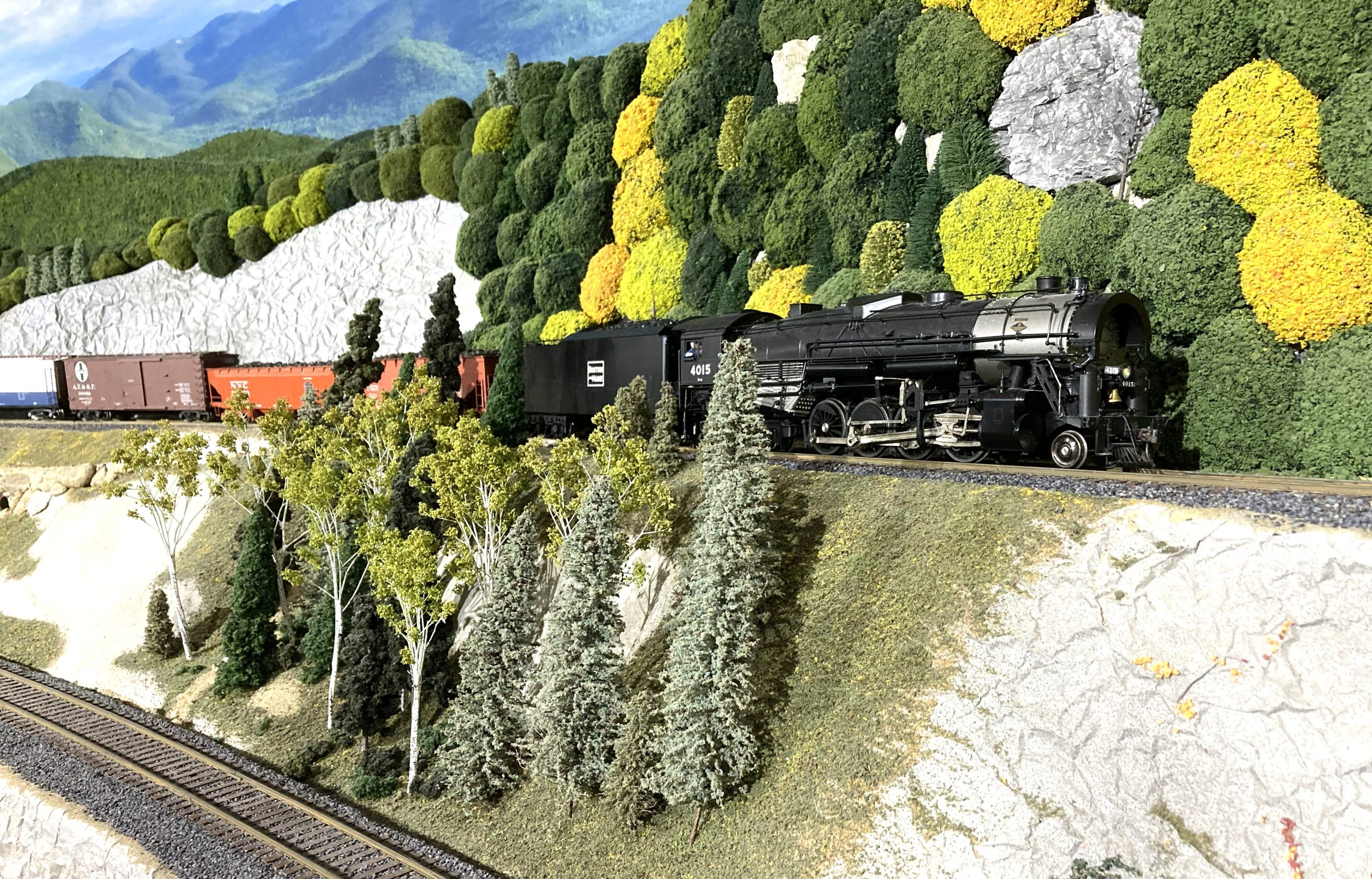
The Boston and Maine/Maine Central Mountain Division is a 2-rail O scale model railroad designed for operation. It is loosely based on the B&M’s Conway branch and the MEC’s climb through Crawford Notch, both in New Hampshire, during the post WW II era when railroads were transitioning from steam power to diesel. History has been modified to provide challenging operation of a model railroad. The Mountain Division is a singletrack railroad nearly 400 feet in length with passing sidings in each town. This requires coordination of train movements to allow opposing trains to pass each other safely. Modeled towns are West Ossipee, North Conway, Bartlett, Crawford’s, Breton Woods, and Twin Mountain. North Conway provides an interchange between the two railroads. Bartlett is the base for the helper locomotives needed to assist trains on the steep climb through Crawford Notch. Breton Woods is home to Scott Paper Company, the major industry on the railroad. Motive power is primarily Boston and Maine or Maine Central but a few “leased” locomotives help keep trains running. Rolling stock is largely typical of what was running in New England in the time frame modeled. Trains modeled depart from Boston MA, Portsmouth NH, and Portland ME in the East (Portsmouth staging) or Montreal QUE, Quebec City QUE, Woodsville NH, St. Johnsbury VT or Beecher Falls VT in the West (Woodsville staging). Each end staging loop includes five tracks, each capable of storing two trains. The loop arrangement allows for turning trains, most of which perform multiple roles. Actual trains such as The Mountaineer and YR-1/RY-2 are included in the operating plan. Others, such as the Red Wing and BU-1/UB-2 have been rerouted over the Mountain Division to suit the needs of a busy model railroad. Still other trains have been fabricated to fill out the operating schedule and enhance the operating fun. There are 30 industries requiring railroad support. These industries offer nearly 100 car spots so switching is an important part of any operating session. Cars are moved based on four-part waybills. A session ends when the allotted time is up and the following session begins where the previous one left off. There is no dispatcher, so engineers coordinate movement based on the provided Train Card instructions, including “meet” locations. 41 assignments run over the course of a “24-hour day”. Trains run in sequence as listed on the Assignment Board.